
Press Release
September Issue of Health and Welfare Policy Forum Released
- Date 2023-09-18
- Hits 1,686
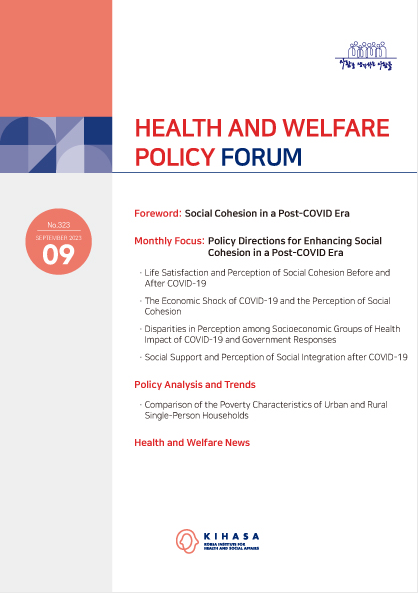
KIHASA has released the September Issue of the Health and Welfare Policy Forum, No. 323. (The articles are available for download here.)
SUMMARY OF THE FOREWORD: "Social Cohesion in a Post-Covid Era," Kim Meegon, President, Korea Labor Force Development Institute for the Aged
What is the first thing that we need to do about social cohesion? The first thing to seek is a conceptual understanding of what it is. Social cohesion is a highly abstract, multidimensional and comprehensive concept. Perhaps this is why it has no internationally agreed-upon definition, in light of which it might as well take a sidestep from the definitional quest toward considering the need for social cohesion and conditions affecting it.
We should also recognize that material disparities in a society are related to its social acceptance. The level of social cohesion in a society may vary depending on the degree to which it is resistant to disparities. To put it another way, a society with a wide rich-poor gap, for example, would have nothing much going against social cohesion if that society was approving and accepting of such a gap. In other words, social cohesion is strongly related to citizens' perceptions. Therefore, understanding people's perceptions is a critical first step. In this respect, I think it is very timely that "perceptions" of post-Covid-19 policies have been chosen as the topic of the monthly focus of this issue of the Health and Welfare Policy Forum.
Then why focus on the time following Covid-19, one might wonder? Covid-19 was a global crisis, and now we are witnessing the great changes it has brought about to the politics, economies, and societies of the world. In Korea, the practice of Covid-19-induced physical (spatial) distancing has been shown to led to social disconnection. Other measures taken to prevent the spread of the disease, such as work-at-home, online classes, and the resulting rise of contactless industries, have likely also reduced opportunities for dialogue, exchange, compromise, cooperation, and participation among different social groups, all of which are essential for social cohesion. In conclusion, the first step is to understand how, and under what material conditions, the perceptions of social cohesion that our social members hold about various policy areas in health care and social welfare have changed after Covid-19.
MONTHLY FOCUS: Policy Directions for Enhancing Social Cohesion in a Post-Covid Era
"Life Satisfaction and Perception of Social Cohesion Before and After COVID-19," Lee Taejin, Woo Sunhee, and Kim Jiwon, KIHASA
In this article, we aim to examine how COVID-19 has affected the perception of social cohesion among individuals and families and explore policy options for strengthening social cohesion. Our analysis found that while Koreans report higher levels of subjective happiness and life satisfaction now compared to 2020, when COVID-19 was at its height, their psychological well-being has deteriorated, as evidenced by their reporting lower levels of social cohesion, trust, and social capital. Furthermore, how Koreans perceive their own lives and society has been increasingly determined depending on the social class with which they are identified, and this trend has become more entrenched. In this light, there is a need to establish policy directions for rebuilding social trust and expanding the government’s role and responsibility in supporting vulnerable members of society. Additionally, effective policies are required to reduce and prevent socioeconomic inequalities and to provide support for individuals to recover from the losses they have suffered due to COVID-19.
"The Economic Shock of COVID-19 and the Perception of Social Cohesion," Lee Wonjin, KIHASA
This article is an analysis of the relationship between people’s perceptions of social cohesion on one hand and the economic impact of COVID-19 and the support provided by the government on the other. COVID-19 has dealt a significant impact on the economy, with one-third of those who were employed before February 2020 experiencing income losses after the onset of the pandemic. The impact was particularly severe on non-regular employees, daily-contract workers, “special-contract” employees, own-account workers, and low-income individuals. We examined survey data on the government’s COVID-19-related aid for self-employed people, employment-vulnerable individuals, and low-income groups. Our findings suggest that lower income levels and higher severity of COVID-19-related economic loss are associated with lower levels of satisfaction with the support received. The perception of social cohesion was lower among those who experienced economic losses due to COVID-19. Higher levels of satisfaction with the government aid received and higher acceptance of not receiving aid were associated with a stronger perception of social cohesion. To enhance social cohesion, it is essential to strengthen social policies aimed at safeguarding people’s employment and reducing poverty.
"Disparities in Perception among Socioeconomic Groups of Health Impact of COVID-19 and Government Responses," Kim Dongjin, KIHASA
This study compared how different population groups perceive the health impact of COVID-19 and the government’s responses to the pandemic. We observed variations in subjective health status changes and the prevalence of depressive symptoms after the onset of COVID-19. We also found variations in health behavior changes among different population groups following COVID-19. In terms of the appropriateness of the government’s responses to COVID-19 in the areas of medical quarantine, social quarantine, and socioeconomic policy, the ratings varied across population groups. Regarding the perception of recovery from COVID-19, population groups with lower physical and mental health levels or socioeconomic status were less likely to perceive their living standards as having returned to their pre-COVID-19 levels.
"Social Support and Perception of Social Cohesion after COVID-19," Kwak Yoon Kyung, KIHASA
Korean society has experienced an overall decline in social support during the COVID-19 pandemic, making it more difficult to build a sense of community and social harmony among its members. Therefore, this article aims to identify the levels and patterns of social support after COVID-19 and draw implications for promoting social cohesion. The main policy implications from this analysis suggest that, firstly, various social service resources should be provided to build social support systems and, secondly, it is necessary to offer psychological support services, such as counseling. However, since policy needs vary across different levels of social support, it is necessary to consider targeted and customized services.
POLICY ANALSYS AND TRENDS
"Comparison of the Poverty Characteristics of Urban and Rural Single-Person Households," Kim Taewan, Lee Jumi, and Choi Junyoung, KIHASA
In this article, we examine how the increase in single-person households, a representative change in family structure, affected poverty in urban and rural areas. In addition, we explore the necessary policies to alleviate poverty among single-person households in rural and urban areas. The rise in single-person households was particularly noticeable among individuals aged 65 and older in rural areas and among those aged 19 to 34 in urban areas. Income levels were lower for single-person households in rural areas than for single-person households in urban areas. As a result of increased public transfers, the disposable-income poverty rate decreased more than the market-income poverty rate in both urban and rural areas. We also examined changes in the poverty rate by age group, sex, and employment status and drew implications for group-specific poverty reduction policies.
HEALTH AND WELFARE NEWS IN BRIEF