
Press Release
December Issue of Health and Welfare Policy Forum Released
- Date 2025-12-16
- Hits 856
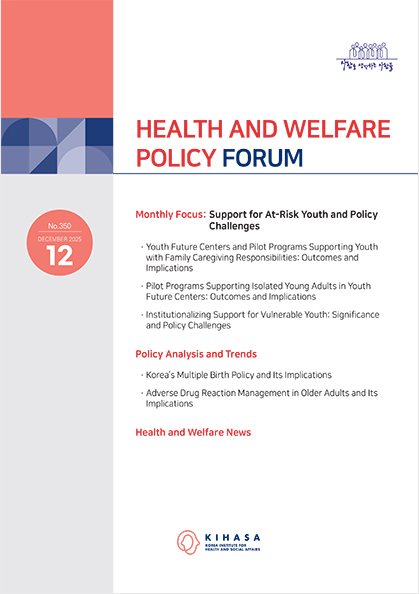
KIHASA has published the December issue (No. 350) of the Health and Welfare Policy Forum. Its monthly focus is "Support for At-Risk Youth and Policy Challenges" (Click here to download this month's articles.)
Young people do have the right to benefit from social welfare. Recognizing young individuals unable to transition effectively to independent adulthood as a “new vulnerable group,” the government established Youth Future Centers in four locations―Incheon, Ulsan, Chungbuk, and Jeonbuk―and launched a pilot of the At-Risk Youth Support Project on August 14, 2024. Over a year into this trial, with the Youth Future Centers continuing to assist young people burdened with family caregiving responsibilities and those living in social isolation, the project has yielded positive outcomes, as shown by participants’ increased willingness to engage in daily activities and their renewed hope of leading self-reliant lives. The At-Risk Youth Support Project is set to officially launch next March, grounded in the Act on Support for Children and Youth at Risk, a law promulgated upon the approval by the State Council in March this year, after its bill passed the National Assembly’s plenary session the preceding month. We expect that with the national rollout of Youth Future Centers and the effect of their programs extending from metropolitan regions down to every vein of smaller municipalities, the central government and local authorities will do their part in full measure, ensuring that no young person facing challenges they cannot handle alone is left without support anywhere in the country. In this month’s Health and Welfare Forum, we revisit what has been achieved through the At-Risk Youth Support Project in its current trial phase, particularly for individuals saddled with family caregiving duties or those living isolated from social interactions, and explore how youth welfare programs can be more firmly established as legally grounded institutions. We hope to see the Youth Support Project become a cornerstone of tailored social safety nets that helps young people at any level of risk cope with whatever hardships life presents them, adjust to the routine of daily life, and transition to independent adulthood.
FOCUS OF THE MONTH: Support for At-Risk Youth and Policy Challenges
Youth Future Centers and Pilot Programs Supporting Youth with Family Caregiving Responsibilities: Outcomes and Implications Ha Solleep, KIHASA
Launched in August last year by the government in four locations across the country, Youth Future Centers have been running pilot programs for at-risk youth―including those with family caregiving responsibilities―providing participants with a self-care allowance and tailored assistance. Initial outcomes of the pilot project indicate positive changes in indicators related to time spent on care duties, subjective caregiving burden, perceived control over one’s life, and overall life satisfaction, with statistically significant improvements seen in the second and last measures. Interviewees reported that the general effect of their participation in the project was such that they became aware of the importance of caring for themselves, a recognition they felt positively influenced their family caregiving and, in turn, made them more willing to take charge in shaping their own futures. As the national rollout of the youth support project approaches, policymakers should consider establishing a framework for regularly evaluating the effectiveness of efforts made by the central and local governments to support youth with family caregiving responsibilities―particularly in reducing care burden―to ensure these services drive lasting, positive change.
Pilot Programs Supporting Isolated Young Adults in Youth Future Centers: Outcomes and Implications Kim Seonga, KIHASA
While some local governments and NGOs had already launched support programs for isolated and reclusive youth, it was only with the opening of the first four Youth Future Centers on August 14, 2024 that the initial national-level step was taken in piloting these efforts. Participants in the first-year pilot of the Support for At-Risk Young Adults Project scored 9.6 points on the LSNS-6(+2) in January 2025, a 0.1-point increase from when they first entered the program. The HQ-25 score, a measure of reclusiveness, dropped from 71.0 to 63.2 points―a 12.3 percent reduction. Life satisfaction scores increased by 49.6 percent, from 2.6 to 3.8 points. The Youth Future Center as a safe physical space was reason enough for the participants to step out of their reclusive lives. The participants met there with staff who were unreservedly supportive as well as peers whose experiences resonated with their own, and, engaging in activities befitting their age, began to reconnect with the normalcy of everyday living, learning to hope for independence and economic self-reliance, gradually setting out on a path of personal growth toward ‘connected independence.’ This study examines the pilot phase outcomes and offers recommendations for improvement.
Institutionalizing Support for Vulnerable Youth: Significance and Policy Challenges Park Kwang Dong, Korea Legislation Research Institute
Enacted on March 25 this year, the Act on Support for Children and Youth with Family Caregiving Responsibilities, etc. lays the legal foundation for the ongoing effort to reduce gaps in support for young people identified as socially withdrawn and isolated or as young family caregivers, an effort that itself marks a significant change to Korea’s youth welfare policy. The Act’s social and policy implications are substantial: it calls for greater state involvement not only in addressing gaps in the existing support system for young people in crisis but also in strengthening their protection and helping them build tailored foundations for independent living. However, the Act faces several limitations in its implementation. A legislative review is needed to clarify responsible organizations, delineate the Act’s jurisdiction over related policy programs, and define the scope of potential beneficiaries.
POLICY ANALYSIS AND TRENDS
Korea's Multiple Birth Policy and Its Implications Bae Hyewon, KIHASA
Even as Korea’s total fertility rate remains among the lowest in the world, the country’s multiple-birth rate continues to one of the highest in the world. This trend is attributable to Korea’s current policies on multiple births. From the continuity-of-care perspective, these policies focus disproportionately on peripartum care as opposed to preconception care. The situation calls for greater emphasis on preventing multifetal conceptions and on making preconception care a top priority in order to optimize maternal and fetal health outcomes. Prenatal care for mothers with multifetal pregnancies should also be more systematically organized. In addition, policymaking should take into account the unique characteristics of multiple births when designing antepartum and perinatal programs, and should consider strengthening medical and care infrastructure, psychosocial services, and caregiving support for mothers of multiples. Further research is needed to track and identify the specific characteristics of multiple births.
Adverse Drug Reaction Management in Older Adults and Its Implications Park Eunja, KIHASA
We take medications expecting them to work as intended, but negative side effects come about at times, which can affect health and may require additional medical services. In the 2023 Korea Health Panel Survey, about 2 percent of adults aged 19 and older reported experiencing drug side effects in the year preceding the survey. Among those without major chronic conditions, 1.35 percent reported having experienced such side effects. The prevalence was 2.64 percent for those with one chronic condition, and 2.67 percent for those with two or more chronic conditions. Of those who reported having had unwanted side effects, an estimated 64.2 percent have, on account of these harms, used inpatient, emergency, or outpatient medical services. The government has recently launched pilot projects aimed at controlling duplicate medication use among individuals on polypharmacy regimens. Given the aging of the population, the need is apparent to make further policy efforts in earnest to promote rational medication use and reduce adverse drug effects.
HEALTH AND WELFARE NEWS IN BRIEF