
Press Release
January Issue of Health and Welfare Policy Forum Released
- Date 2026-01-28
- Hits 2,564
KIHASA has published the January issue (No. 351) of the Health and Welfare Policy Forum. Its monthly focus is "Prospects and Tasks for Health and Social Welfare Policies in 2026" (Click here to download this month's articles.)
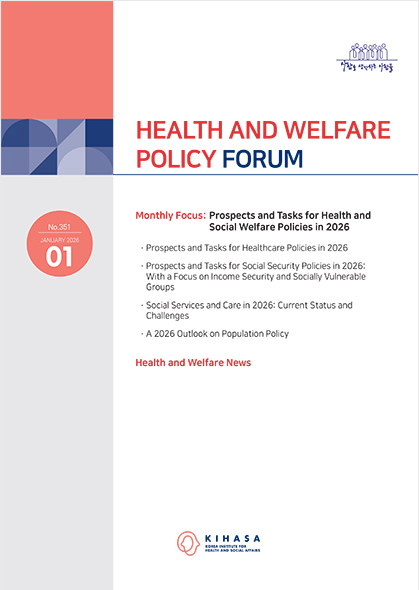
SUMMARY OF THE FOREWORD
Korea’s socioeconomic scene is expected to change rapidly this year, propelled by continued low fertility and population aging, shifts in the labor market, and technological innovation in the health and welfare sectors. The need is greater than ever for policies intended to secure quality of life for citizens and ensure equity among all members of society.
The January issue of The Health and Welfare Forum brings together four articles that offer an outlook on some of the changes due this year in social policies. One article presents a new vision and strategic directions for healthcare policies. Another article, the one on social security, discusses new developments in income security and support for socially vulnerable groups. The third article, concerned with social services, explores the state of affairs of “care” for older adults, disabled people, and children as part of Korea’s social service system, and identifies challenges that are current in the domain of care and suggests ways in which they should be dealt with. The article on population policies focuses on policy options that can be considered as a response to depopulation and regional disparities. We hope the discussions advanced in this month’s issue will offer a basis from which to proceed to efforts to establish a social safety net highly responsive to new social risks and contribute to making sustainable social security policies with appreciable impacts on the lives of citizens.
FOCUS OF THE MONTH: Prospects and Tasks for Health and Social Welfare Policies in 2026
Prospects and Tasks for Healthcare Policies in 2026 Shin HyunWoung; Yeo Nageum
The aim of this article is to present “healthcare for all” as a new vision for healthcare policy in 2026. Implemented separately with a provider-centric approach, policies in different categories of healthcare―local healthcare, essential healthcare, and public healthcare―have been less effective than intended in reducing healthcare gaps, despite increasing resources allocated to them. This article advocates for a paradigm shift in healthcare policy, from a provider-oriented to user-oriented model, from “more” provision to “smart” provision. The proposed model consists of four layers of care, thus taking on a “3+1 structure”: Basic Care guarantees four fundamental healthcare rights for all citizens; Close-At-Hand Care addresses immediate healthcare needs at the local level, ensuring they are met thoroughly within the local region; Personalized Care provides fine-tuned responses to needs particular to individuals that may fall outside the scope of both Basic Care and Close-At-Hand Care; and AI-Assisted Care serves as a common thread throughout these layers, integrating them into an efficient whole. The article also outlines the necessary steps to realize the proposed vision of a people-centered system that guarantees fundamental healthcare rights for all.
Prospects and Tasks for Social Security Policies in 2026: With a Focus on Income Security and Social Vulnerable Groups Kim Taewan
In this article, I provide an outlook, based on the current government’s national agenda, on the policy changes expected this year in income security and in support for socially vulnerable groups. In income security, measures on the horizon include revisions to eligibility criteria and support-obligor rules for livelihood allowances and medical benefits. As a follow-up to the National Pension reforms implemented earlier in 2025, discussions are likely to continue regarding the development of a multi-pillar old-age income security system. Now that pilot basic income programs for artists and rural residents are on course for implementation, the effect they may have on the existing system warrants attention. Concerning socially vulnerable groups, progress in policy discussions on socially isolated youth and financially disadvantaged individuals should be closely monitored. There are additional changes planned for 2026 that should also be kept under review for their effects on the social security system.
Social Services and Care in 2026: Current Status and Challenges Hwang JuHee; Kim Sejin; Lee Juyeon; Kim Yuhwi
This article examines what care consists of in Korea’s social service system, reviews how matters stand with care policies for different demographic groups―older adults, disabled individuals, and children―and explores ways these policies could proceed in alignment with the current government’s key agenda. Despite the expansion in Aging in Place through broader application of long-term care insurance and the integrated community care program, eldercare remains insufficient in preventive interventions, limited in the volume and diversity of services, and marked by persistent regional disparities. Care for disabled people, grounded in the principle of deinstitutionalization and supported independent living, is in need of resolving the potential conflicts between the Act on Supporting the Independence and Residential Transition of Persons with Disabilities and the Integrated Community Care Support Act, clarifying the direction of support for older persons with disabilities, and strengthening the skills and sustainability of the workforce providing care for individuals with severe disabilities. Child care, amid the expansion of all-day care arrangements, requires the consolidation and qualitative improvement of services, the establishment of a mechanism that can respond effectively to “children left alone” and other situational gaps in care, and the development of robust support infrastructure for children who provide care within their families.
A 2026 Outlook on Population Policy Lee Soyoung; Park Jongseo
Korea is beset by a demographic shift characterized by an entrenched trend of low fertility, accelerating population aging, and local depopulation. Despite sustained government efforts since the enactment of the Framework Act on Low Birth Rate in an Aging Society in 2005, along with a medium- to long-term basic plan renewed every five years, demographic trends have continued to worsen, leading to further contraction of the general and working-age populations and to widening regional disparities. This article examines the characteristics of population change specific to Korea against the backdrop of the global demographic transition, traces the evolution of its population policies, and outlines, based on national policy strategies, the key directions in which population policies may proceed in 2026. Korea’s population policies will need to shift away from short-term fertility promotion measures and instead focus on long-term structural reforms in governance and institutions that enhance quality of life, ensure individuals’ right to choose, and reduce regional disparities.
HEALTH AND WLEFARE NEWS IN BRIEF