
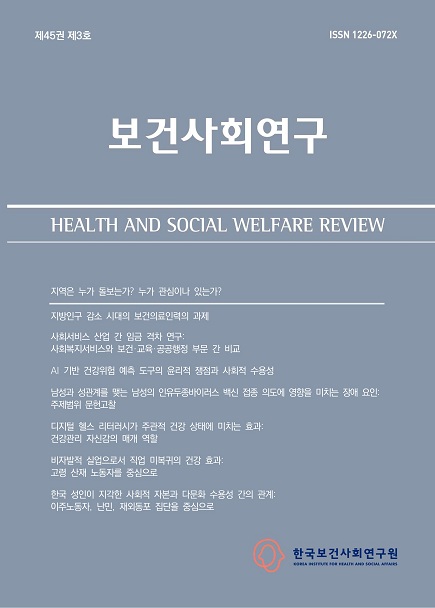
보건사회연구Health and Social Welfare Review
- ISSN : 1226-072X(Print), 2671-4531(Online)
- 창간일 : 1981.07.31
- 최신호 : 제46권 제3호
KCI Impact Factor
4.22KCI Impact Factor
1981 - 2026Available
46Volumes
121Issues
1713Articles
- Open Access
- 1713 ArticlesOpen Access 바로가기
Latest Articles
제46권 제3호Vol.46, No.3
이 권호에 27개 논문이 있습니다.
Joo, Eunsun(Kyonggi University) 보건사회연구, Vol.46, No.3, pp.1-3 https://dx.doi.org/10.15709/hswr.2026.46.3.1
Hyeon, Ockju(Korea Institute for Health and Social Affairs) ; Kim, Jimin(Yonsei University) 보건사회연구, Vol.46, No.3, pp.4-27 https://dx.doi.org/10.15709/hswr.2026.46.3.4
Abstract
This study aimed to analyze the effects of household background and career education programs received by vocational high school adolescents on stable employment and job adaptation, which are early-career labor market outcomes. For this purpose, we used the Korean Education and Employment Panel Survey to analyze how household background and career education programs received at age 17 by students in two cohorts influenced labor market outcomes during early adulthood (ages 20-25) by using a latent growth model. The main results are summarized as follows. First, only experience with career-related assessments showed a significant positive effect on stable employment and job adaptation in the 1st cohort, whereas in the 2nd cohort, more diverse career education programs—including information provision, work experience and practical workplace connections, job fairs, and graduate mentoring—positively influenced both stable employment and job adaptation. Second, household income and paternal education level had significant effects on stable employment in the 1st cohort, whereas in the 2nd cohort, household income, paternal education level, and private tutoring expenses all showed significant positive effects on both stable employment and job adaptation. These findings suggest the need for enhanced job experience programs with practical work connections, improved future career exploration strategies, and policies addressing socioeconomic inequality during adolescence.
초록
본 연구는 직업계고 청소년의 가구배경과 진로교육이 청년 초기 노동시장 성과에 미치는 영향을 분석하고자 하였다. 이를 위해 한국교육고용패널조사의 1차 웨이브(2009~2014년) 중학교 3학년 코호트와 2차 웨이브(2019~2024년) 고등학교 2학년 코호트를 활용하였다. 각 코호트의 가구배경과 진로교육 경험이 청년 초기의 안정적 일자리 취업과 직업적응에 미치는 영향을 잠재성장모형으로 분석하고, 두 코호트의 결과를 비교하였다. 분석 결과, 첫째, 1차 코호트는 진로 관련 검사 경험만이 안정적 일자리 취업과 직업적응에 유의미한 정적 영향을 미친 반면, 2차 코호트에서는 정보제공 및 안내, 직업체험 및 실무연결, 취업박람회 및 졸업생 멘토링 등 다양한 진로교육이 안정적 일자리 취업과 직업적응에 긍정적 영향을 미치는 것으로 나타났다. 둘째, 1차 코호트는 가구소득과 부의 학력만이 안정적 일자리 취업에 유의미한 영향을 미쳤으나, 2차 코호트에서는 가구소득, 부의 학력, 사교육비 지출이 안정적 일자리 취업과 직업적응 모두에 유의미한 정적 영향을 미쳤다. 이를 바탕으로 직업체험과 실무연결의 강화, 진로 탐색 기회 확대, 청소년기 사회경제적 불평등 해소 등 정책·실천적 제언을 하였다.
Ahn, Suran(Korea Institute for Health and Social Affairs) ; Eo, Yugyeong(Korea Institute for Health and Social Affairs) 보건사회연구, Vol.46, No.3, pp.28-49 https://dx.doi.org/10.15709/hswr.2026.46.3.28
Abstract
This study aims to empirically examine the factors influencing the application of the price elasticity system to the child and adolescent psychological support service introduced as a pilot program in 2024. Using survey data collected from 300 users of the service across 11 metropolitan cities and provinces, a logistic regression analysis was conducted to assess the effects of need-related factors, choice-related factors, quality-preference factors, and institutional factors on the application of the price elasticity system. The results show that the odds of adopting the price elasticity system increase significantly when the child is younger, the duration of service use is shorter, and the user’s income level is higher. In contrast, quality-preference factors and institutional factors do not have a statistically significant effect on the application of the price elasticity system. Based on these findings, this study discusses the need to create an environment that promotes user choice through competition in service quality, institutional improvements to mitigate user stratification, and the potential for expanding the application of the system to other services.
초록
이 연구는 2024년 시범사업으로 도입된 아동·청소년 심리지원 서비스 이용자의 가격탄력제 적용에 영향을 미치는 요인을 실증적으로 분석하는 것을 목적으로 한다. 이를 위해 가격탄력제를 도입한 11개 시·도의 아동·청소년 심리지원 서비스 이용자 300명의 실태조사 자료를 활용하여, 욕구 요인, 선택 가능 요인, 품질 선호 요인, 제도 요인이 가격탄력제 적용에 미치는 영향을 로지스틱 회귀분석을 통해 검증하였다. 분석 결과, 아동의 연령이 낮을수록, 서비스 이용기간이 짧을수록, 이용자 등급이 높을수록 가격탄력제 적용의 승산비가 유의하게 증가하는 것으로 나타났다. 반면, 품질 선호 요인과 제도 요인은 가격탄력제 적용에 통계적으로 유의미한 영향을 미치지 않았다. 이러한 분석 결과를 토대로 서비스 품질 경쟁에 따른 이용자 선택을 활성화할 수 있는 환경 조성 필요성, 이용자 계층화 현상을 완화하기 위한 제도적 개선 방안, 그리고 타 서비스로의 확대 적용 가능성을 논의하였다.
Ahn, Seon-Kyeong(Ewha Womans University) ; Chung, Ick-Joong(Ewha Womans University) ; Kim, Sangmi(University of Tennessee) ; Kim, Soyoun(National Center for the Rights of the Child) ; Nho, Choong Rai(Ewha Womans University) ; Kim, Seonga(Korea Institute for Health and Social Affairs) 보건사회연구, Vol.46, No.3, pp.50-75 https://dx.doi.org/10.15709/hswr.2026.46.3.50
Abstract
This study explored how adverse life experiences of isolated and reclusive young adults during pre-adulthood were associated with adverse experiences in adulthood. Using data from the 2022 Seoul Metropolitan City Isolated and Reclusive Young Adults Survey, 486 participants were selected as the study sample. The findings are as follows: First, adverse life experiences during pre-adulthood were classified into three types: Complex High-Adversity (17.5%), Moderate-Adversity (65.2%), and Low-Adversity (17.3%). Adverse life experiences during adulthood were classified into four types: Complex High-Adversity (21.2%), Employment and Relationship Frustration (22.6%), Academic Frustration (16.7%), and Low-Adversity. Second, the transition analysis showed that adverse life experiences in pre-adulthood and adulthood were not isolated events but were interrelated, exhibiting patterns of maintenance, intensification, and alleviation. In addition, the analysis identified transition types that were not captured in the transition probability analysis. Third, based on the transition patterns, the participants were categorized into four groups: the High-Risk Maintenance Group (8.4%), the Low-Risk Maintenance Group (13.8%), the Upward-Risk Transition Group (45.3%), and the Downward-Risk Transition Group (32.5%). Fourth, significant differences among groups were observed in gender, household socioeconomic status, health status, and the desire for and attempts to change their isolated and reclusive status, according to the transition patterns. By situating adverse life experiences within a developmental continuity framework, this study contributes to the understanding of heterogeneity among isolated and reclusive young adults and provides an empirical basis for tailored interventions.
초록
본 연구는 고립은둔 청년이 경험한 성인기 전의 부정적 생애경험과 성인기 후 부정적 생애경험의 전이관계를 살펴보았다. 2022년 서울특별시 고립은둔 청년 실태조사 자료 중 19~39세 고립은둔 청년 486명을 대상으로 하였으며, 분석 결과는 다음과 같다. 첫째, 고립은둔 청년의 부정적 생애경험은 경험 수준에 따라 성인기 전은 복합고위기형(17.5%), 잠재위기형(65.2%), 저위기형(17.3%), 성인기 후는 복합고위기형(21.2%), 취업/관계좌절형(22.6%), 학업좌절형(16.7%), 저위기형(39.5%)으로 분류되었다. 둘째, 전이양상을 살펴본 결과 성인기 전과 후의 부정적 생애경험은 단절된 사건이 아니라 상호작용 속에서 유지·심화·완화되는 양상을 보였으며, 전이패턴에서는 전이확률에서 발견되지 않은 유형이 발견되었다. 셋째, 전이패턴에 따라 집단을 분류한 결과 고위기 유지집단(8.4%), 저위기 유지집단(13.8%), 위기상향 집단(45.3%), 위기하향 집단(32.5%)으로 분류되었다. 넷째, 전이패턴에 따른 집단별 특징으로 성별과 가구의 주관적 사회경제적 수준과 건강상태, 고립은둔 변화욕구 및 변화시도 여부에서 집단 간 유의하게 나타났다. 본 연구는 발달의 맥락에서 부정적 생애경험의 전이양상과 패턴에 따른 특성을 탐색함으로써 새로운 취약집단에 대한 이해를 확장하였다는 점에서 학술적 의미가 있다.
Hur, Hae Jin(Dankook University) ; Jeon, Hye Seong(Dankook University) 보건사회연구, Vol.46, No.3, pp.76-98 https://dx.doi.org/10.15709/hswr.2026.46.3.76
Abstract
This study was conducted to examine the mediating paths of rejection sensitivity and cognitive flexibility in the relationship between perceived maternal psychological control and interpersonal competence among university students. To this end, an online survey was conducted with 300 university students attending four-year universities in the Seoul metropolitan area, and 284 cases were used for the final analysis after excluding insincere responses. Data were analyzed using IBM SPSS Statistics 26 and Hayes' (2017) PROCESS macro (ver. 4.2) Model 6. The main findings were as follows. First, the higher the level of perceived maternal psychological control, the lower the interpersonal competence of university students. Second, rejection sensitivity and cognitive flexibility significantly mediated the relationship between maternal psychological control and university students' interpersonal competence. Third, rejection sensitivity and cognitive flexibility showed a sequential mediating effect in the relationship between maternal psychological control and university students' interpersonal competence. Maternal psychological control increased rejection sensitivity, and the path through which this reduced interpersonal competence via a decrease in cognitive flexibility was significant. These findings suggest the need to establish counseling and educational systems encompassing cognitive, emotional, and behavioral dimensions at the university level, and to build a psychological safety net that includes the early identification of high-risk students and linkage to family counseling.
초록
본 연구는 대학생이 지각한 모의 심리적 통제와 대인관계 유능성의 관계에서 거절 민감성과 인지적 유연성의 매개 경로를 확인하기 위해 수행되었다. 이를 위해 수도권 소재 4년제 대학에 재학 중인 대학생 300명을 대상으로 온라인 설문조사를 실시하여, 응답이 불성실한 사례를 제외한 총 284부를 최종 분석에 사용하였다. 자료 분석은 IBM SPSS Statistics 26과 Hayes(2017)의 PROCESS macro (ver. 4.2) Model 6을 사용하였다. 주요 연구 결과로, 첫째, 모의 심리적 통제 수준을 높게 지각할수록 대학생 자녀의 대인관계 유능성이 낮아지는 경향이 파악되었다. 둘째, 거절 민감성과 인지적 유연성은 모의 심리적 통제와 대학생의 대인관계 유능성의 관계를 유의하게 매개하는 것으로 나타났다. 셋째, 거절 민감성과 인지적 유연성은 모의 심리적 통제와 대학생의 대인관계 유능성 간의 관계에서 순차적 매개효과를 보였다. 모의 심리적 통제는 거절 민감성을 증가시키고, 이는 인지적 유연성의 저하를 통해 대인관계 유능성을 감소시키는 경로가 유의하였다. 이러한 결과는 대학 차원에서 인지·정서·행동을 아우르는 상담 및 교육 체계를 구축하고, 고위험군 조기 발굴과 가족 상담 연계를 포함한 심리적 안전망을 마련할 필요가 있음을 시사한다.
Tak, Hyeonsam(University of Maryland) 보건사회연구, Vol.46, No.3, pp.99-122 https://dx.doi.org/10.15709/hswr.2026.46.3.99
Abstract
This study examines objective income, subjective socioeconomic status, and perceived economic security as determinants of outgroup exclusion. Using data from the 2024 Social Integration Survey, it analyzes how these factors are associated with attitudes toward five outgroups. The findings show that objective income, subjective status, and perceived economic security are related to outgroup acceptance in opposite directions. Individuals with higher subjective status and greater perceived economic security report significantly lower levels of outgroup exclusion. By contrast, individuals with higher objective income report stronger exclusionary attitudes toward outgroups. In the Korean context, this pattern may reflect the way material affluence reduces perceived dependence on others and strengthens a sense of self-sufficiency. When coupled with meritocratic beliefs, material affluence may also reinforce the defense of existing privilege and weaken social solidarity. The study shows that outgroup exclusion in Korea is not simply a response to resource scarcity. It is also associated with status inconsistency, especially when objective income is high but subjective status and perceived economic security are low. These findings suggest that efforts to reduce social conflict and promote social integration should move beyond a growth-centered focus on income. They should instead emphasize life predictability and psychological security. A more integrative society also requires broader sources of subjective status, supported by a social climate in which multiple forms of value are recognized rather than judged by a single material standard.
초록
본 연구는 외집단 배제의 핵심 동인으로 기존 연구에서 주목해 온 객관적 소득뿐만 아니라 주관적 사회경제적 지위와 경제적 안정감에 주목하고, 이들 변수가 다섯 가지 외집단에 대한 태도에 미치는 영향을 2024 사회통합실태조사 데이터를 활용해 분석한다. 연구 결과, 개인이 인지하는 주관적 지위와 경제적 안정감이 높을수록 외집단에 대한 배타성은 유의미하게 감소하였으나 객관적 소득수준이 높을수록 외집단에 대한 배타적 태도는 오히려 강화되는 현상이 관찰되었다. 본 연구는 한국 사회에서 외집단에 대한 배타성이 단순한 자원의 결핍이 아닌, 객관적 소득은 높으나 주관적 지위와 안정감이 낮은 지위 불일치에서 기인함을 실증적으로 규명하였다는 것에 의의가 있다. 사회 갈등 해소와 통합을 위해서는 단순한 소득 증대 중심의 성장 담론에서 벗어나, 구성원의 삶의 예측 가능성을 높이고 심리적 안정감을 제고하는 패러다임의 전환이 시급함을 시사한다. 또한, 단일한 물질적 잣대가 아닌 다양한 가치가 존중받는 사회적 분위기를 조성함으로써 개인이 자신의 삶을 평가할 수 있는 주관적 지위의 원천을 다변화해야 한다.
Kim, Daeun(Seoul National University) 보건사회연구, Vol.46, No.3, pp.123-144 https://dx.doi.org/10.15709/hswr.2026.46.3.123
Abstract
This study identified heterogeneous profiles of family values among unmarried women in their 20s to 40s and examined the effects of family value profiles on marriage intentions using the Theory of Planned Behavior as an analytical framework. Data were drawn from the 9th wave (2022) of the Korean Longitudinal Survey of Women and Families, and latent profile analysis and multinomial logistic regression were conducted with 1,496 unmarried women. The main findings were as follows. First, three distinct family value profiles were identified: traditional normative acceptance, ambivalent value orientation, and post-traditional acceptance. Second, the factors associated with profile membership differed across the three groups. Compared with the ambivalent value orientation group, membership in the traditional normative acceptance group was associated with more traditional gender-role attitudes, greater expectations of family support, being employed, and having a religious affiliation, whereas membership in the post-traditional acceptance group was associated with more gender-egalitarian attitudes and more open perceptions of diverse family forms. Third, marriage intentions differed significantly across family value profiles. Compared with the ambivalent value orientation group, women in the traditional normative acceptance group were less likely to report no intention to marry, whereas those in the post-traditional acceptance group were more likely to report either no intention to marry or having never considered marriage. These findings underscore the need to understand marital decision-making as a multidimensional process.
초록
본 연구는 20~40대 미혼 여성을 대상으로 가족가치관의 이질적 유형을 도출하고, 계획된 행동이론을 분석틀로 하여 가족가치관 유형이 결혼의향에 미치는 영향을 검증하였다. 이를 위해 2022년 여성가족패널조사 9차년도 자료를 활용하여 미혼 여성 1,496명을 대상으로 잠재프로파일분석과 다항 로지스틱 회귀분석을 실시하였다. 주요 연구 결과는 다음과 같다. 첫째, 가족가치관은 전통 규범 수용형, 절충적 가치형, 탈전통 수용형의 세 가지 유형으로 구분되었다. 둘째, 가족가치관 유형별 관련 요인은 상이하게 나타났다. 절충적 가치형에 비해 전통 규범 수용형은 전통적인 성역할 가치관, 높은 가족지원 기대 인식, 취업 상태 및 종교가 있는 경우와 관련된 반면, 탈전통 수용형은 성평등적인 성역할 가치관과 개방적인 가족형태 인식과 관련되었다. 셋째, 가족가치관 유형에 따라 결혼의향의 차이가 확인되었다. 절충적 가치형에 비해 전통 규범 수용형은 결혼의향이 없을 가능성이 낮았고, 탈전통 수용형은 결혼의향이 없거나 생각해 본 적이 없을 가능성이 높게 나타났다. 이러한 연구 결과에 기반하여 혼인 의사결정을 다차원적으로 이해할 필요성을 제시하였다.
Yang, Nanjoo(Daegu University) ; Shin, Yumi(Daegu University) 보건사회연구, Vol.46, No.3, pp.145-167 https://dx.doi.org/10.15709/hswr.2026.46.3.145
Abstract
This study empirically examines the determinants of Family Care Worker (FCW) utilization within Korea's Long-Term Care Insurance (LTCI) system from an intersectional perspective integrating gender and socioeconomic factors. Despite the LTCI system's foundational goal of defamilializing elder care, FCW utilization has grown steadily since the system's inception in 2008. Using administrative big data from the National Health Insurance Service (NHIS), the study analyzes 973,384 older adults aged 65 and above who first received LTCI home-care benefits between 2008 and 2019. A Linear Probability Model (LPM) was applied to examine three-way interaction effects among the primary caregiver relationship (spouse vs. adult child), the care recipient's gender, and economic status (co-payment exemption/reduction vs. standard). The findings show that spousal caregiving is associated with a significantly lower probability of FCW utilization. However, this effect is markedly attenuated among male care recipients receiving care from their wives, and further amplified when those men belong to low-income households. No comparable pattern emerges for female care recipients. These results demonstrate that FCW utilization is structurally shaped by the intersection of gendered caregiving norms and socioeconomic conditions, operating in direct tension with the LTCI system's stated goals of defamilialization and gender equality.
초록
이 연구는 노인장기요양보험제도 가족인 요양 이용의 영향 요인을 젠더와 계층의 교차적 관점에서 실증 분석하였다. 돌봄의 탈가족화를 표방한 노인장기요양보험제도에서 등급인정자가 가족관계에 있는 요양보호사에게 방문요양을 받는 가족인 요양 이용의 증가에 주목하여, 수급노인 성별, 주수발자와의 관계(배우자 또는 자녀), 소득 수준이 가족인 요양 이용에 미치는 영향과 그 상호작용 효과를 검증하였다. 분석자료는 국민건강보험공단 노인장기요양보험 행정데이터로, 2008년부터 2019년 사이에 최초로 장기요양 인정등급을 받아 재가급여를 이용하기 시작한 65세 이상 노인 973,384명을 대상으로 하였다. 이분 종속변수에 대한 삼중 상호작용 효과를 확인하기 위해 선형확률모형(LPM)을 적용한 분석 결과, 배우자가 주수발자인 경우 자녀가 주수발자인 것에 비해 가족인 요양을 이용할 확률이 유의하게 낮았으나 수급노인의 성별과 소득수준에 따라 가족인 요양 이용에 상반되는 상호작용 효과가 확인되었다. 수급노인이 남성이면 주수발자가 배우자인 경우 가족인 요양 이용 확률이 높아졌고, 남성 수급노인이 저소득층이면 이러한 상호작용효과는 더 강화되었다. 즉, 아내가 있는 저소득 남성 수급노인 집단에서 가족인 요양을 이용하는 경향이 뚜렷하게 나타났다. 이 결과는 가족인 요양 이용이 젠더화된 돌봄 규범과 계층적 조건이 교차하는 구조적 맥락 속에서 이루어진다는 점을 실증적으로 보여준다.
Kim, Jeehyun(National Medical Center) ; Lee, Eun-Hoo(National Medical Center) ; Kim, Myoung-Hee(National Medical Center) 보건사회연구, Vol.46, No.3, pp.168-192 https://dx.doi.org/10.15709/hswr.2026.46.3.168
Abstract
Older people in nursing homes are particularly vulnerable to infectious diseases, yet studies quantifying the impact of the COVID-19 pandemic on their mortality remain limited. To estimate excess mortality among older nursing home residents during the pandemic, we analyzed mortality data from Statistics Korea for individuals aged ≥65 years who died in social welfare facilities between 2015 and 2022. A seasonal autoregressive integrated moving average model fitted to 2015–2019 data was applied to estimate expected deaths for 2020–2022, which were compared with observed deaths. Excess mortality during 2020–2022 was estimated at 6,992 deaths (95% confidence interval [CI]=142.7–15,027.4), approximately 15% above the expected level, and was concentrated in 2022 (6,191.2, 95% CI=2,899.6–10,057.6). Significant excesses were observed for “not elsewhere classified” (R00-R99, 3,089.2, 95% CI=1,422.1–4,775.9), neoplasms (734.4, 95% CI=604.0–865.9), and diseases of the genitourinary system (139.6, 95% CI=78.8–201.1), whereas deaths from mental and behavioral disorders and from external causes were lower than expected. These findings are consistent with indirect pandemic effects, such as healthcare system strain and disrupted chronic disease management, although studies linking healthcare utilization data are required to disentangle the mechanisms.
초록
본 연구는 통계청 사망원인 통계자료(2015-2022년, 65세 이상)를 이용하여 SARIMA 모형을 구축하고 코로나19 팬데믹 기간 요양시설 노인의 초과 사망을 추정하였다. 2020–2022년 초과 사망은 6,992명(95% 신뢰구간 142.7–15,027.4)이었으며, 2022년에 집중되었다(6,191.2명, 95% 신뢰구간 2,899.6–10,057.6). 사인별로는 달리 분류되지 않은 증상 및 임상소견(3,089.2명, 95% 신뢰구간 1,422.1–4,775.9), 신생물(734.4명, 95% 신뢰구간 604.0–865.9), 비뇨생식계 질환(139.6명, 95% 신뢰구간 78.8–201.1)에서 유의한 초과 사망이 관찰된 반면, 정신 및 행동장애와 외인에 의한 사망은 기대보다 적었다. 이는 의료체계 부담 및 만성질환 관리의 어려움 등 팬데믹의 간접적 영향과 부합하나, 기전 규명을 위한 의료이용 자료와의 연계 등 후속 연구가 필요하다.
Seo, Minjae(University of Seoul) 보건사회연구, Vol.46, No.3, pp.193-215 https://dx.doi.org/10.15709/hswr.2026.46.3.193
Abstract
This study examined how multi-layered social support networks are differentially associated with perceptions of well-dying among older adults in South Korea. Drawing on the Convoy Model, three layers of social support―household type, relationships with adult children, and satisfaction with friendships and community ties―were analyzed using layer-specific ordered logistic regression models with data from the 2023 Korean National Survey of Older Persons. Older adults living alone reported significantly lower perceived importance of self-arrangement prior to death and minimizing burden on others than older adults living in couple households. The number of reachable adult children showed consistent positive associations across all five dimensions of well-dying, while satisfaction with friendships and community ties exhibited the largest effect sizes, particularly for painless dying and burden minimization. These findings suggest that perceptions of well-dying in later life reflect sociostructural conditions rather than individual attitudes alone and call for layer-specific intervention strategies to address social inequalities in well-dying among older adults.
초록
본 연구는 사회적 지지 관계망의 다층적 구조와 노인의 웰다잉 인식 간의 차별적 연관성을 탐색하고자 하였다. 가족 중심의 웰다잉 가치가 강한 한국 사회에서 사회적 관계망의 해체와 독거노인의 증가는 노인이 좋은 죽음을 인식하고 준비하는 방식에 구조적 균열을 야기할 수 있다. 이에 본 연구는 Convoy Model을 이론적 틀로 삼아, 배우자(가구 형태), 자녀 관계, 친구·지역사회 관계 만족도라는 세 층위의 사회적 지지가 웰다잉 인식에 미치는 영향을 층위별 분리 모델로 분석하였다. 2023년 노인실태조사의 노인 부부 가구 및 독거 가구를 대상으로 순서 로지스틱 회귀분석을 실시한 결과, 독거노인은 부부 가구 노인에 비해 임종 전 자기 정리와 가족·지인에 대한 부담 최소화 차원의 중요도를 유의하게 낮게 인식하였다. 자녀 관계는 웰다잉 인식의 5개 하위 차원 모두에서 유의한 정적 효과를 나타내 가장 보편적인 지지 자원으로 기능한 반면, 친구 및 지역사회 관계는 고통 없는 임종과 부담 최소화 차원에서 세 모델의 사회적 지지 변수 중 가장 큰 효과 크기를 보였다. 이러한 결과는 노년기 웰다잉 인식이 단순한 태도의 차이가 아닌 사회구조적 맥락과 깊이 연관되어 있음을 보여준다. 본 연구 결과를 토대로 사회적 지지 관계망의 층위별 개입 전략을 통해 노년기 웰다잉의 사회적 불평등을 완화하기 위한 후속 연구와 정책 설계가 필요함을 제안하고자 한다.
Na, Jihun(Daegu Catholic University) ; Jang, Eunji(Dong-A University) 보건사회연구, Vol.46, No.3, pp.216-242 https://dx.doi.org/10.15709/hswr.2026.46.3.216
Abstract
This study examines the impact of perceived parental neglect on depression among adolescents from international marriage families, specifically focusing on the mediating role of social withdrawal and the moderated mediation effect of a prosocial school environment. Data were analyzed from the Multicultural Adolescents Panel Study(MAPS), involving 1,283 participants. PROCESS macro (Models 4 and 14) and bootstrapping were employed for hypothesis testing. The key findings are as follows: First, parental neglect exerted a significant direct effect on adolescent depression. Second, social withdrawal partially mediated the relationship between parental neglect and depression, indicating that neglect exacerbates depression both directly and indirectly. Third, a prosocial school environment significantly moderated the link between social withdrawal and depression, effectively attenuating the negative impact of withdrawal. Consequently, the moderated mediation effect was confirmed. Based on these results, this study suggests multilayered intervention strategies, including parent education to reduce neglect, school-based early screening systems, and the cultivation of prosocial school environments to prevent depression among children from international marriage families.
초록
본 연구는 국제결혼가정 자녀가 인지한 부모방임이 우울에 미치는 영향을 검증하고, 그 과정에서 사회적 위축의 매개효과와 친사회적 학교환경의 조절된 매개효과를 통합적으로 분석하는 데 목적이 있다. 이를 위해 한국청소년정책연구원의 다문화청소년패널조사(MAPS) 자료를 활용하였으며, 국제결혼가정 자녀 1,283명을 분석 대상으로 하였다. 분석 방법으로는 PROCESS macro의 Model 4, 14를 적용하여 조절된 매개효과를 검증하였고, 부트스트래핑(bootstrapping) 방법을 통해 간접효과의 유의성을 확인하였다. 주요 분석 결과는 다음과 같다. 첫째, 국제결혼가정 자녀가 인지한 부모방임은 우울에 유의한 직접적 영향을 미치는 것으로 나타났다. 둘째, 부모방임이 우울에 미치는 영향에서 사회적 위축의 부분매개효과가 유의하게 확인되었다. 셋째, 친사회적 학교환경은 사회적 위축과 우울 간의 관계를 유의하게 조절하는 것으로 나타났으며, 친사회적 학교환경 수준이 높을수록 사회적 위축이 우울에 미치는 부정적 영향이 완화되었다. 이를 통해 본 연구는 국제결혼가정 자녀의 우울 예방을 위해 부모 교육을 통한 ‘부모방임’ 인식 개선, 학교 기반의 조기 선별 체계 구축, 친사회적 학교환경의 강화가 유기적으로 결합된 다층적·통합적 개입 전략이 필요함을 제언하였다.
Chu, Yoosun(Keimyung University) ; DAO, VAN SANG(Keimyung University) 보건사회연구, Vol.46, No.3, pp.243-262 https://dx.doi.org/10.15709/hswr.2026.46.3.243
Abstract
This study aims to analyze acculturation types of marriage migrant women in Korea based on Berry’s (1997) acculturation theory. Using data from the 2024 Multicultural Families Survey (N = 12,862), this study conducted latent class analysis (LCA) and BCH three step multinomial logistic regression to identify factors associated with latent groups. The study identified Berry’s four acculturation types―integration, assimilation, separation, and marginalization―in the Korean context. Acculturation types among marriage migrant women varied significantly not only by individual characteristics (e.g., age and length of residence) but also by relational and structural factors, including spousal and parent–child relationship satisfaction, parenting efficacy, legal status, and experiences of discrimination. The findings offer several policy related implications.
초록
본 연구는 Berry(1997)의 문화적응 이론에 근거하여 결혼이주여성의 문화적응 잠재집단 유형을 실증적으로 분석하였다. 2024년 전국다문화가족실태조사의 12,862명을 대상으로 잠재집단분석을 실시하였고, 문화적응유형과 관련된 특성을 파악하기 위해 BCH 3단계 다항로지스틱 회귀분석을 실시하였다. 분석 결과 네 개의 잠재집단이 도출되었으며, 이를 모국문화유지와 주류문화수용의 두 축에 따라 통합형, 동화형, 분리형, 주변화형으로 명명하였다. 또한 결혼이주여성의 문화적응유형은 연령과 해외 총 교육연수, 거주기간과 같은 개인적 특성뿐 아니라 출신 지역, 취업상태, 자녀 및 배우자와의 가족관계 만족도, 양육효능감, 체류자격, 차별경험과 같은 사회적 요인에 따라 유의한 차이를 보였다. 가족관계 만족도와 양육효능감이 낮을수록 통합형에 비해 분리형에 속할 가능성이 높았으며, 차별경험이 있는 경우 분리형과 주변화형에 속할 가능성이 높았다. 또한 한국국적취득자에 비해 체류자격이 결혼이민으로 불안정한 경우 분리형에 속할 가능성이 가장 높은 것으로 나타났다. 본 연구는 결혼이주여성의 문화적응을 단순한 개인의 선택이 아닌 사회적 관계망과 제도적 지위, 차별과 같은 구조적 요인과 밀접하게 연결되어 있음을 실증적으로 제시하였다는 데 의의가 있다.
Lee, Sion(Seoul National University) ; Son, Seulki(Institute of Health and Environment, Seoul National University) 보건사회연구, Vol.46, No.3, pp.263-284 https://dx.doi.org/10.15709/hswr.2026.46.3.263
Abstract
This study examines whether the diffusion of generative AI differentially affected the mental health of young workers across industries with different levels of AI exposure. Using the 2022 and 2024 Youth Life Survey, we analyzed 7,117 workers aged 19 to 34 employed in industries with high or low AI exposure before and after the release of ChatGPT. We measured depression with the Patient Health Questionnaire-9 (PHQ-9) and applied a propensity score weighted difference-in-differences approach. Propensity scores were estimated for each period and combined with survey design weights. Depression increased significantly more among young workers in industries with high AI exposure than among those in industries with low AI exposure. Exploratory mediation analysis indicated a significant indirect effect through perceived job loss risk related to technological displacement. Life satisfaction, burnout, and self-rated health also showed parallel deterioration. This study provides initial quasi-experimental evidence on the mental health effects of generative AI diffusion among young workers, suggesting that AI policies should address mental health in addition to employment support and vocational training.
초록
본 연구는 생성형 인공지능(AI)이 촉발한 기술 충격이 청년 근로자의 우울에 미치는 영향을 분석하였다. ChatGPT 출시 이전인 2022년과 출시 이후인 2024년에 실시된 청년 삶 실태조사 자료 기반 만 19~34세 청년 7,117명의 응답을 대상으로 하며, 산업 수준의 AI 노출도를 처치변수로, PHQ-9으로 측정한 우울점수를 결과변수로 각각 설정하고, 성향점수 가중 이중차분법을 적용해 ChatGPT 출시 전후의 차별적 변화를 추정했다. 그 결과, AI 고노출 산업 청년 근로자의 우울점수는 저노출 산업 대비 유의하게 악화되었으며, 기술변화에 따른 직무상실 인식의 간접효과가 탐색적 매개분석에서 유의하게 나타났다. 삶의 만족도, 소진, 주관적 건강 역시 모두 우울과 일관된 방향으로 변화하여 AI 충격이 전반적인 재직 청년의 주관적 안녕에 미치는 부정적 효과가 확인되었다. 본 연구는 생성형 AI 확산이 청년 근로자의 우울에 차별적으로 미치는 영향을 준실험적으로 검증한 초기 연구로서 현행 AI 청년 정책이 고용 보호와 직업훈련에 치중하는 동안, 정신건강이라는 주요 정책 의제가 상대적으로 소외되고 있음을 밝혔다는 점에서 의의가 있다.
Kim, Jimin(Sungkyunkwan University) ; Han, Changkeun(Sungkyunkwan University) 보건사회연구, Vol.46, No.3, pp.285-305 https://dx.doi.org/10.15709/hswr.2026.46.3.285
Abstract
In a rapidly aging society, we need to recognize middle-aged and older adults as autonomous members of society and draw on their experiences and resources rather than treating them as ‘recipients of protective or care services’. In addition, household assets—a factor of growing significance—should be considered when examining prosocial behaviors in later life. Although household assets function as a mechanism of social inequality, this study posits that these assets may also influence giving behaviors and examines the relationship between household assets and giving among Korean middle-aged and older adults. This study classified giving behaviors into four subgroups: neither (1), donation only (2), volunteering only (3), and both (4). The 2022 Seoul Welfare Survey (N = 6,598), conducted by the Seoul Institute, was used for the analyses, and the final analytical sample consisted of 2,463 citizens aged 50 or older. Multinomial logistic regression models were conducted to examine associations between specific household assets (i.e., real estate assets, financial assets, other assets, and debts) and types of giving. The main results of multinomial logistic regression analyses are as follows. First, real estate assets were positively associated with membership in the ‘donation only (2)’ group while other assets and total debt were positively associated with membership in the ‘volunteering only (3)’ group. The ‘both (4)’ group showed positive associations with real estate and other assets. In this regard, real estate assets showed strong associations with giving behaviors among middle-aged and older adults. Based on these findings, we highlight potential significance of household assets for giving behaviors and suggest tailored approaches to promote giving behaviors in later life.
초록
초고령화 사회인 오늘날 중·고령자는 단지 보호, 개입의 대상만이 아니라 사회의 주체적인 일원이며, 이들의 자본과 경험을 활용할 시대적 필요성이 강조되고 있다. 또한, 중·고령자의 적극적 행동을 이해하려면 소득뿐만 아니라 가구 자산이란 새롭게 강조되는 변수를 고려할 필요가 있다. 본 연구는 자산이 친사회적 행동의 영향요인 중 하나라고 전제하여, 가구 자산이 중·고령층의 나눔행동(모두 미참여, 기부만 참여, 봉사만 참여, 모두 참여)에 미치는 영향을 구분하여 살펴보고자 한다. 서울연구원의 ‘2022년 서울시복지실태조사(N=6,598)’를 활용하였으며, 만 50세 이상 가구원 2,463명을 최종적으로 분석하였다. SPSS 29.0을 활용하여 유형별 나눔행동을 준거집단(ref.)으로 설정한 후 다항 로지스틱 회귀분석을 실시한 주요 결과는 다음과 같다. ‘모두 미참여(ref.)’한 경우를 위주로 요약하자면, 부동산 자산은 ‘기부만 참여’할 가능성을 증가시켰고, 기타 자산과 총부채가 많을수록 ‘자원봉사만 참여’할 가능성이 높아졌다. 가장 적극적인 나눔행동인 ‘모두 참여’하는 경우는 부동산 자산과 기타 자산이 많은 경우로 나타나, 부동산 자산의 강한 영향력을 확인할 수 있었다. 연구 결과를 바탕으로, 초고령화 사회에서 중·고령층의 나눔행동을 촉진할 새로운 영향요인으로 가구 자산을 살펴보았다는 이론적 함의를 마련했고, 중·노년기의 나눔행동을 증진할 맞춤형 접근의 필요성이란 실천적 전략을 강조하였다.
Rhee, YungSeon(Chosun University) 보건사회연구, Vol.46, No.3, pp.306-324 https://dx.doi.org/10.15709/hswr.2026.46.3.306
Abstract
This study constructed a 3-item candidate health literacy screening tool based on the HLS-EU-Q16 and evaluated its classification performance using Korea Health Panel data. Data from 8,358 adults with complete HLS-EU-Q16 responses were analyzed. Three candidate combinations were constructed based on item distributions, corrected item-total correlations, internal consistency, exploratory factor analysis, and content representativeness. Low health literacy was defined as a full-scale score of 12 or lower. Split-sample validation and sensitivity analyses were conducted. Candidate 1 (HLIT1, HLIT8, and HLIT12) had a Cronbach’s α of .787 and a correlation of r=.902 with the full scale. At a cutoff score of 2 or lower, sensitivity was 98.2%, specificity 78.8%, accuracy 88.3%, negative predictive value 97.8%, balanced accuracy 88.5%, and AUC 0.965. Its AUC ranked second among all 560 possible 3-item combinations, while its sensitivity and negative predictive value were higher than those of the top-AUC combination. In the validation sample, sensitivity and negative predictive value were 98.3% and 98.0%, respectively. Candidate 1 showed potential as a brief screening tool for rapidly identifying individuals at risk of low health literacy.
초록
본 연구는 한국의료패널 자료를 활용하여 HLS-EU-Q16 기반 3문항 건강문해력 선별 후보도구를 구성하고 분류 성능을 평가하는 것을 목적으로 수행하였다. 연구 대상은 완전응답 성인 8,358명이며, 문항분포, 문항–총점 상관, 내적 일관성, 요인분석 및 내용적 대표성을 검토하여 세 예비조합을 구성하였다. 원척도 12점 이하를 저건강문해력군으로 정의하고 표본분할 및 민감도 분석을 시행하였다. 연구 결과 예비조합1(HLIT1, HLIT8, HLIT12)은 Cronbach’s α=.787, 원척도와의 상관 r=.902였다. 2점 이하 기준에서 민감도 98.2%, 특이도 78.8%, 정확도 88.3%, 음성예측도 97.8%, 균형정확도 88.5%, AUC 0.965였다. 560개 조합 중 AUC는 2위였고, 최고 조합보다 민감도와 음성예측도가 높았다. 검증표본에서도 민감도 98.3%, 음성예측도 98.0%였다. 예비조합1은 저건강문해력 위험군을 신속히 포착하기 위한 3문항 선별 후보도구로 활용 가능성이 있다.
Kim, Gyu Hwan(Korea Employment Information Service) 보건사회연구, Vol.46, No.3, pp.325-348 https://dx.doi.org/10.15709/hswr.2026.46.3.325
Abstract
This study aimed to classify work-related perceptions among middle-aged and older adults in Seoul who are currently unemployed but wish to obtain wage employment, and to examine differences across the identified groups. The analysis used raw data from the 2025 Seoul Middle-aged and Older Adults Job Demand Survey conducted by the Seoul 50 Plus Foundation. Based on items measuring the perceived meaning of work and factors considered important in the job-search process, three groups were identified. Group 1 was labeled the life stability-oriented type, Group 2 the work meaning realization type, and Group 3 the livelihood-prioritizing realistic type. Group 1 reported moderate levels of perceived meaning of work and perceived job importance overall, while placing greater emphasis on livelihood maintenance and stable employment. Group 2 reported high levels of both perceived meaning of work and perceived job importance. Group 3 placed high importance on livelihood but reported relatively low levels of perceived meaning of work and perceived job importance in areas other than livelihood. The group-difference analysis showed significant differences in gender, education level, real estate assets, financial assets, self-efficacy, life satisfaction, and demand for employment-related policies. These findings suggest the need for tailored employment services and reemployment support policies that take into account differences in work-related perceptions among middle-aged and older adults.
초록
본 연구는 현재 취업하지 않았으나 임금근로자로의 취업을 희망하는 서울지역 중고령자를 대상으로 이들의 일에 대한 인식을 유형화하고, 도출된 집단 간 차이를 살펴보기 위해 수행되었다. 분석에 활용한 자료는 2025년 서울시50플러스재단에서 수행한 서울시 중장년 일자리 수요조사 원자료이다. 이 중 일의 의미에 관한 문항과 구직 과정에서 중요하게 생각하는 일자리 요인 관련 문항을 활용하여 총 3개의 그룹을 도출하였다. 각 집단은 그룹1(생활안정 지향형), 그룹2(일의미 실현형), 그룹3(생계우선 현실형)으로 구분하였다. 그룹1은 일의 의미와 일자리 중요도를 전반적으로 중간 수준에서 인식하면서 생계 유지와 안정적 취업을 중시하는 집단이며, 그룹2는 일의 의미와 일자리 중요도를 전반적으로 높게 인식하는 집단이다. 그룹3은 생계에 대한 중요도는 유지하고 있으나 일의 의미와 생계를 제외한 일자리 중요도는 상대적으로 낮게 인식하는 집단이다. 집단 간 차이분석에서는 성별, 학력, 부동산 자산, 금융 자산, 자기효능감, 삶의 만족도, 일자리 정책 수요에서 집단 간 차이가 나타났다. 이러한 결과는 중고령층의 일에 대한 인식 유형을 고려하여 맞춤형 고용서비스와 재취업지원 정책을 제공할 필요가 있음을 시사한다.
Bae, Jungeun(Korea Institute for Health and Social Affairs) ; Lee, Haewoo(Dongguk University Ilsan Hospital) ; Choi, Jihee(Korea Institute for Health and Social Affairs) ; Chae, Sumi(Korea Institute for Health and Social Affairs) 보건사회연구, Vol.46, No.3, pp.349-373 https://dx.doi.org/10.15709/hswr.2026.46.3.349
Abstract
Climate-related disasters are increasing in frequency and severity, with impacts extending beyond physical health to include mental health. This study aimed to develop and validate a measurement tool specific to the Korean context, the Climate Crisis Mental Health Scale (CCMHS), to systematically assess mental health risks associated with the climate crisis. The conceptual framework was established based on climate risk determinants as outlined in the IPCC Sixth Assessment Report. Five preliminary domains and their corresponding items were developed through a literature review and an expert survey. An online survey using the preliminary scale was conducted with 2,019 adults aged 19–64. Through factor analyses and subsequent reliability and validity testing of the three domains measuring mental health risk—dysfunction, emotion, and worry—the CCMHS was finalized as a 17-item standard version and an 11-item short-form version, within a broader five-domain framework including sociodemographic characteristics and climate crisis-related experiences. The CCMHS enables a multidimensional assessment of climate-related mental health risks by integrating emotional and functional dimensions and provides an empirical foundation for climate adaptation policies that incorporate mental health considerations in South Korea.
초록
기후변화로 인한 재난·재해의 빈도와 강도가 증가함에 따라 그 영향은 신체적 건강 피해뿐만 아니라 정신건강 문제까지 확장되었다. 이 연구의 목적은 기후위기로 인한 정신건강 위험을 체계적으로 평가할 수 있는 한국형 측정 도구를 개발하고, 도구의 타당성을 검증하는 데 있다. 평가 영역은 2022년 IPCC 6차 평가보고서에서 제시한 기후위험의 결정 요인을 고려하여 구성하였으며, 선행연구 고찰과 전문가 의견 조사를 바탕으로 5개의 예비 영역과 문항을 도출하였다. 이후 만 19-64세 성인 2,019명을 대상으로 온라인 설문조사를 실시하고, 수집된 자료에 대한 요인분석과 타당도, 신뢰도 검증을 수행하였다. 최종적으로 인구·사회학적 특성, 기후위기 관련 경험, 기능장애, 감정, 걱정의 5개 영역을 구성하였으며, 이 중 정신건강 위험을 측정하는 기능장애, 감정, 걱정의 3개 영역에 대해 표준형 17문항과 단축형 11문항을 확정하여 기후위기 정신건강 위험 척도(Climate Crisis Mental Health Scale, CCMHS)를 개발하였다. 이 척도는 다양한 정서적 반응과 기능적 영향을 통합적으로 반영함으로써 기후위기로 인한 정신건강 위험을 다차원적으로 평가할 수 있다는 특징이 있다. 이는 국내 기후위기로 인한 정신건강 위험을 실증적으로 파악하기 위한 기초 자료를 제공하며, 정신건강을 고려한 기후위기 적응 정책의 근거 기반 강화에 기여할 수 있다.
Yang, Jae Eun(Korea Health Industry Development Institute) 보건사회연구, Vol.46, No.3, pp.374-392 https://dx.doi.org/10.15709/hswr.2026.46.3.374
Abstract
This study examines the gap between the institutional adoption and actual implementation of telemedicine by integrating R&D investment structure, regulatory constraints, and system complexity across technology domains. The analysis covers ten telemedicine-related R&D programs implemented by the Ministry of Health and Welfare in Korea from 2023 to 2026. Investment patterns were analyzed across four technology domains, while the Regulatory Constraint Index (RCI) and System Complexity Index (SCI) were constructed as exploratory composite indices based on relevant laws and guidelines and on healthcare information policy and system implementation conditions, respectively. The results showed that 75.1% of total R&D investment was concentrated in the Data and Artificial Intelligence (Data–AI) domains, where relatively high RCI and SCI values were also observed. In contrast, the Monitoring and Platform domains exhibited different RCI and SCI profiles, while SCI values ranged from 1.83 to 2.00 across all four technology domains. Rather than establishing a causal relationship, these findings identify an exploratory pattern in which technology domains receiving concentrated R&D investment overlap with domains characterized by relatively greater regulatory and system-level implementation constraints. The findings suggest that telemedicine R&D policy should consider technological investment and the regulatory and system conditions required for implementation jointly rather than as separate policy domains. Accordingly, R&D portfolio design should incorporate an assessment of the alignment between domain-specific investment priorities and implementation conditions.
초록
본 연구는 비대면 진료의 제도적 허용과 실제 구현 간의 격차를 분석하기 위해 R&D 투자 구조, 규제 제약 및 시스템 복잡성을 기술 도메인별로 통합하여 분석하였다. 분석 대상은 2023년부터 2026년까지 보건복지부에서 추진된 비대면 진료 관련 R&D 사업 10개이며, 기술 도메인별 투자 구조를 분석하고 관련 법·지침을 기반으로 규제 제약 지수(Regulatory Constraint Index, RCI)를, 의료정보 정책자료 및 시스템 구축 현황을 기반으로 시스템 복잡성 지수(System Complexity Index, SCI)를 탐색적 복합지표로 산출하였다. 분석 결과, 전체 R&D 투자의 75.1%가 데이터와 인공지능(Data–AI) 영역에 집중되어 있었으며, 이들 영역에서 상대적으로 높은 RCI와 SCI가 함께 나타나는 중첩 패턴이 관찰되었다. 반면, 모니터링과 플랫폼은 서로 다른 RCI와 SCI 분포를 보였으며, SCI는 전체 기술 도메인에서 1.83~2.00의 범위에 분포하였다. 이러한 결과는 인과적 관계를 의미하기보다, R&D 투자가 집중된 기술 영역과 규제·시스템 차원의 구현 제약이 상대적으로 높은 영역이 중첩될 수 있음을 보여주는 탐색적 결과이다. 본 연구는 비대면 진료 R&D 정책에서 기술 개발 투자와 실제 구현에 필요한 규제 및 시스템 조건을 분리하여 접근하기보다, R&D 포트폴리오 설계 단계에서 기술 도메인별 투자 방향과 구현 조건의 정합성을 함께 점검할 필요가 있음을 제시한다.
Lee, Sun-a(Korean National Police University) ; Roh, Seungkook(Korean National Police University) 보건사회연구, Vol.46, No.3, pp.393-418 https://dx.doi.org/10.15709/hswr.2026.46.3.393
Abstract
This study explored the applicability of a proactive social risk sensing system by extracting future signals related to drug-impaired driving from Naver news articles and user comments through text mining and KEM/KIM(Keyword Emergence Map / Keyword Issue Map) analysis. It further examined the extent to which these signals corresponded with subsequent policy changes from an ex-post perspective. The analysis revealed that discourses surrounding drug-impaired driving were primarily structured around social risk perception, public health and patient safety, and criminal justice responses. While news articles focused on the contextual factors behind drug-impaired driving, online comments reflected public sentiment—such as concerns about driving after medication and questions about the thresholds for imposing penalties—thereby functioning as complementary indicators of public opinion. Furthermore, the future signals derived from these discourses demonstrated a clear correspondence with retrospective legislative changes. This implies that future-signal analysis—grounded in the competing interpretations inherent in weak signals while guarding against simplistic causal interpretations—can serve as an exploratory tool when combined with expert judgment to detect emerging issues early before they evolve into formal policy agendas. Based on these findings, this study highlights the necessity of shifting from predominantly punitive and reactive measures toward preventive policy frameworks that prioritize public health and patient safety, alongside strengthened regulation of illicit narcotic prescriptions, distribution control, and medical ethics. Ultimately, it presents the potential of future-signal-based social risk perception techniques as exploratory tools for establishing data-driven public health policies.
초록
텍스트마이닝을 활용한 사회적 위험 선제적 인지 시스템의 정책 활용 가능성 탐색을 위해, 약물 운전 관련 네이버 뉴스 기사와 댓글에 대하여 텍스트 마이닝 및 KEM/KIM 분석을 통하여 미래 신호를 도출하고 이를 사후적 관점에서 정책 변화와 어떠한 방식으로 조응하는지 살펴보았다. 분석 결과, 약물 운전에 대한 담론은 사회적 위험 인식, 공중보건과 환자 안전, 형사사법 대응을 중심으로 형성되었고, 뉴스 기사는 약물 운전의 배경적 요인에 주목하고, 댓글은 복약 후 운전에 대한 불안, 처벌 기준에 대한 의문을 표시하는 등 대중의 인식을 반영하는 상호보완적인 여론 지표로서 기능하는 것이 나타났다. 이와 더불어 약물 운전 관련 담론에서 도출된 미래 신호는 사후적 관점에서 약물 운전 관련 입법 변화와 조응 관계를 보였으며, 이는 미래 신호 분석이 약신호의 경쟁적 해석 가능성을 바탕으로 단순 인과론적 해석을 경계하고 전문가 판단과 결합하여, 정책의제로 발전할 가능성이 있는 이슈를 조기에 탐지하는 탐색적 도구로 활용될 수 있음을 시사하였다. 이러한 결과를 바탕으로 처벌 중심의 사후 대응에 국한되지 않고 공중보건과 복약 환자 안전을 고려한 예방 중심의 정책적 접근, 마약류의 불법 처방, 유통 관리와 의료인의 윤리적 책임 강화 노력의 필요성과 데이터 기반 보건 정책 수립에 미래 신호 기반의 사회적 위험 인지 기법의 탐색적 도구로서의 활용 가능성을 제시하였다.
Choi, Yeon-woo(Korea University) ; Yoon, Seok-Jun(Korea University) 보건사회연구, Vol.46, No.3, pp.419-441 https://dx.doi.org/10.15709/hswr.2026.46.3.419
Abstract
This study aimed to examine the longitudinal association between post-retirement economic activity and health status and healthcare utilization among middle-aged and older adults in South Korea, conceptualizing retirement as a gradual transition process rather than a complete exit from the labor market. Using data from the 1st to 9th waves (2006–2022) of the Korean Longitudinal Study of Aging (KLoSA), we analyzed 3,065 retirees aged 50–80, comprising 12,715 observations. Participants were classified as fully retired (n=2,435) or partially retired (n=630). The study compared health status and healthcare utilization between the two retirement groups and additionally examined the association between time-varying employment status and health outcomes among partially retired individuals. Mixed Models for Repeated Measures (MMRM) and Generalized Estimating Equations (GEE) were employed to account for repeated measurements and longitudinal changes. Partially retired individuals had significantly lower odds of being diagnosed with a psychiatric disorder than fully retired individuals (OR=0.53, p=0.008). Among partially retired individuals, being employed was associated with significantly lower inpatient out-of-pocket expenditure (β=−0.12, p=0.006), lower inpatient cost per hospitalization (β=−0.06, p=0.010), and fewer outpatient visits (IRR=0.86, p=0.007) than being non-employed. These findings suggest that remaining economically active after retirement may be associated with better mental health and lower inpatient healthcare utilization among older adults. Beyond labor force participation itself, the results imply that sustaining social roles and flexible economic participation after retirement may have important implications for healthy aging and health policy in aging societies.
초록
본 연구는 한국의 고령화 추세 속에서 은퇴를 단순한 노동시장 이탈이 아닌 점진적 전환 과정으로 정의하고, 은퇴 후 재근로 여부가 중·고령층의 건강 상태 및 의료 이용에 미치는 영향을 종단적으로 분석하였다. 고령화 연구 패널조사(KLoSA) 1~9차(2006~2022년) 자료를 활용하여 만 50~80세 은퇴자 3,065명을 분석하였으며, 완전 은퇴자(2,435명)와 부분 은퇴자(630명)의 의료 이용을 비교하는 집단 간 분석과, 부분 은퇴자 내에서 시점별 경제활동 상태가 의료 이용에 미치는 영향을 추정하는 개인 내 분석을 반복 측정 혼합모형(MMRM)과 일반화 추정 방정식(GEE)으로 수행하였다. 분석 결과, 집단 간 분석에서 완전 은퇴자 대비 부분 은퇴자의 정신과적 질환 진단 오즈가 유의하게 낮았다(오즈비=0.53, p=0.008). 개인 내 분석에서는 경제활동 상태 유지 시 비경제활동 상태 대비 입원 본인부담 비용(β=−0.12, p=0.006), 입원 1회당 비용(β=−0.06, p=0.010)이 유의하게 낮았으며, 외래진료 횟수 발생률비(IRR=0.86, p=0.007)도 유의하게 낮았다. 본 연구는 은퇴 후 경제활동 상태의 지속이 고령자의 일부 의료이용 및 정신건강 지표와 관련될 가능성이 있음을 시사하며, 이러한 결과는 고령층의 경제활동 참여를 독려하는 정책이 단순히 노동력 확보를 넘어 노년기 건강 불평등 완화와 건강한 노화를 위한 보건 정책적 근거가 될 수 있음을 보여준다.
Kim, Euihyun(Kyung Hee University) 보건사회연구, Vol.46, No.3, pp.442-466 https://dx.doi.org/10.15709/hswr.2026.46.3.442
Abstract
This study applies the Andersen Behavioral Model to data from the 2023 Survey of Older Koreans to examine the determinants of willingness to use six paid home care services supporting Aging in Place (AIP). Since the survey asked about payment intention only among those who reported needing a given service, this study examines the stage at which perceived need is converted into willingness to bear the cost, rather than service use itself. Whereas previous applications of the model have primarily addressed whether publicly funded services are used, for which eligibility is determined by assessed functional need, this study analyzes older adults' own willingness to bear the cost of private services, where no such screening exists. Applying an identical specification across six services further confirms that the observed factor structure is not confined to any single service. Education level, subjective economic status, and opportunities for neighborhood interaction were significant positive predictors across all six services, whereas need factors were significant for only some services and varied in direction. The formation of payment intention after need recognition is thus explained more consistently by individual resources than by functional status, indicating that older adults with limited resources are less likely to secure services through the private market. The study proposes dual access pathways within the same service according to ability to pay, together with support for establishing service supply capacity and public provision of service information.
초록
본 연구는 2023년 노인실태조사를 바탕으로 앤더슨 행동모델을 적용하여, 6개 재가서비스(주거환경 개선, 일상생활 지원, 안전 지원, 방문 의료·건강 서비스, 병·의원 동행 및 외출 지원, 상담 서비스)의 유료 이용의향 결정요인을 분석하였다. 노인실태조사는 각 서비스가 필요하다고 응답한 노인에 한하여 본인 부담 이용 의향을 질문하므로, 본 연구는 서비스의 필요가 인식된 이후 그것이 이용 의사로 전환되는 국면을 분석 대상으로 삼는다. 기존 앤더슨 모델 적용 연구들이 주로 기능 상태에 따라 수급 자격을 심사하는 공적 급여의 이용 여부를 다루어 온 것과 달리, 본 연구는 자격 심사가 존재하지 않는 민간 서비스 영역을 대상으로, 노인 당사자의 본인 부담 의사를 분석함으로써 모델의 적용 범위를 확장하였다. 또한 6개 서비스에 동일한 모형을 반복 적용하여 요인 구조가 특정 서비스에 국한된 현상이 아님을 확인하였다. 분석 결과, 교육수준과 주관적 경제상태, 이웃교류기회는 6개 서비스 전부에서 유의한 정적 영향을 보인 반면, 욕구요인은 일부 서비스에서만 유의하였고 영향의 방향도 서비스에 따라 상이하였다. 즉 필요 인식 이후의 지불 의사 형성은 기능 상태보다 개인이 보유한 자원에 의해 더 일관되게 설명되었다. 이는 자원 수준이 낮은 노인이 민간 시장을 통해 서비스를 확보하기 어려움을 의미하는바, 이를 토대로 동일 서비스 내에서 지불 능력에 따라 접근 경로를 이원화하는 설계와 민간 서비스의 공급 기반 조성 및 공적 정보 제공을 제언하였다.
Lee, Minhong(Dong-Eui University) 보건사회연구, Vol.46, No.3, pp.467-482 https://dx.doi.org/10.15709/hswr.2026.46.3.467
Abstract
This study aims to analyze the effectiveness of a rights-based case management capacity-building program for social workers who provide case management services at senior welfare centers. A nine-session online program was provided to 38 social workers from two senior welfare centers in the Busan region. Using a historical control group design, chi-square and mean-difference tests confirmed that there were no statistically significant differences between the baseline measures for the intervention group and the historical comparison group in terms of socio-demographic characteristics and the extent of rights-based case management implementation. Compared with the baseline assessment, the intervention group demonstrated a statistically significant increase in the mean extent of rights-based case management implementation at the post-intervention assessment (p < .001). The effect size, measured by Cohen’s d, was moderate (d = .66), demonstrating the effectiveness of the rights-based case management capacity-building program for social workers at senior welfare centers. Based on these findings, this study discusses strategies for enabling social workers to implement rights-based case management in the field of senior welfare practice. Finally, the study identifies limitations that could potentially compromise the internal validity of the program's effectiveness and suggests directions for future research.
초록
본 연구는 노인복지관에서 사례관리를 수행하는 사회복지사를 참여자로 노인 권리기반 사례관리 역량강화 프로그램을 제공해서 효과성을 분석하는 것을 목적으로 한다. 부산지역 2개 노인복지관의 사회복지사 38명에게 9회기 온라인 프로그램을 제공했다. 역사적 대조군 연구설계로 실험군의 사전조사와 비교군의 인구사회학적 특성과 권리기반 사례관리 실행 정도가 교차분석과 평균차이검증을 통해서 통계적으로 차이가 없음을 확인하였다. 실험군은 사전조사와 비교해서 사후조사에 권리기반 사례관리 실행 정도 평균이 통계적으로 유의하게 향상되었다(p<.001). 효과크기는 Cohen’s d 값이 중간 수준(.66)으로 노인복지관 사회복지사의 노인 권리기반 사례관리 역량강화 프로그램의 효과성을 보여준다. 연구 결과를 토대로 노인복지실천 현장에서 사회복지사가 노인의 권리에 기반해서 사례관리를 실행하는 방안에 대해 논의하였다. 끝으로 프로그램 효과성의 내적 타당도를 저해할 수 있는 연구 한계점과 향후 연구 방향을 제시하였다.
Joo, Bohye(Korea Institute for Health and Social Affairs) 보건사회연구, Vol.46, No.3, pp.483-502 https://dx.doi.org/10.15709/hswr.2026.46.3.483
Abstract
This study aims to examine the normative framework for guaranteeing the housing rights of older adults at the end of life, with a focus on Germany’s Specialized Outpatient Palliative Care (Spezialisierte ambulante Palliativversorgung, SAPV) system, and to derive policy implications for the Korean legal framework. While existing studies have approached hospice and palliative care primarily as issues concerning the expansion of medical or long-term care services, this study distinguishes itself by reframing the issue from the perspective of housing rights. The analysis demonstrates that Germany provides eligible insured persons with an enforceable entitlement to specialized outpatient palliative care and operates this system as an institutional mechanism supporting continued residence at the end of life within a social insurance framework comparable to that of Korea. The German SAPV system takes the qualitative notion of a “familiar home environment” as its normative point of departure, institutionalizing the assessment of the home-care environment and the organization of care there through the Koordination (coordination) benefit. It also evaluates the necessity of inpatient hospice care and the availability of home-based alternatives through the assessment algorithm developed by the Medical Service (Medizinischer Dienst Bund, MD Bund). In particular, the assessment guidelines (Begutachtungsanleitung) updated in 2026, which codify procedural mechanisms for determining the limits of home-based care, offer concrete legal-policy implications for Korean society, where significant institutional gaps in end-of-life care remain unaddressed. This study confirms the validity of the German SAPV model as a comparative legal reference framework for addressing the problem of death concentration in medical institutions in Korea, and can inform institutional reform toward a rights-based end-of-life care system.
초록
본 연구는 임종기 노인이 살던 곳에서 돌봄을 받으며 삶을 마무리할 수 있는 조건을 주거권의 관점에서 분석한다. 임종기 주거권을 비자발적 거처 이동에 대한 보호라는 소극적 차원, 거주 지속에 필요한 돌봄 지원이라는 적극적 차원, 거처에 관한 결정에서 당사자의 의사와 정당한 절차를 보장하는 절차적 차원으로 구성하고, 독일 전문외래완화의료(SAPV)의 법령, 지침, 계약을 검토한다. 분석 결과, 독일 법제는 법정 요건을 충족한 피보험자에게 요양시설을 포함한 익숙한 거처에서 전문 완화의료를 받을 급여 청구권을 인정한다. 또한 초기 사정을 통해 가정의 돌봄 자원과 부담을 확인하고, 필요한 돌봄을 조직하는 조정을 독립된 급여로 보상한다. 입원형 호스피스의 급여 요건에는 환자의 희망과 재가 돌봄의 불충분성이 포함되며, 질병금고의 의뢰를 받은 독립적 의료지원단은 대안적 돌봄 가능성을 검토하고 처방이나 신청과 다른 권고의 사유를 제시한다. 독일 사례는 임종기 주거권을 실질적으로 뒷받침하려면 당사자의 선택을 존중하는 데 더하여 거주 지속에 필요한 급여와 돌봄 조정, 의사결정 절차를 함께 마련해야 함을 시사한다.
Yu, Sangmin(University of Seoul) ; Lee, Yun-Suk(University of Seoul) 보건사회연구, Vol.46, No.3, pp.503-523 https://dx.doi.org/10.15709/hswr.2026.46.3.503
Abstract
This study examined the relationship between online contact and changes in subjective health among adult game users who had experienced social isolation. It focused on the mediating role of perceptions of game-based social relationships. Previous research has primarily focused on the quantity of online activity. Less attention has been paid to the relationship between online social contact, perceived social relationships, and health. Using data from the Game User Panel Survey (2020–2024) conducted by the Korea Creative Content Agency, we analyzed 1,230 observations from 552 adult game users. All participants had experienced social isolation at least once during the study period. We conducted a bootstrap-based mediation analysis. The results showed a positive indirect effect of online contact on changes in subjective health through game-based social relationship perception. However, online contact also had a negative direct effect that was not explained by this mediator. Exploratory analyses by age group showed a significant positive indirect effect among middle-aged adults aged 45–55. No significant indirect effect was found among younger adults. These findings suggest that policies for socially isolated individuals should consider both the potential benefits and adverse aspects of online interaction. Online and offline support programs should also reflect differences in how online social relationships are connected to health across age groups.
초록
본 연구는 사회적 고립을 경험한 성인 게임 이용자를 대상으로 온라인 접촉과 건강상태 변화의 관계를 분석하고, 게임 이용을 통해 형성되는 사회적 관계인식의 매개역할을 검토하였다. 기존 연구는 온라인 활동의 양적 효과에 주목해왔으나, 온라인 환경에서의 사회적 접촉과 관계인식이 건강과 갖는 관련성은 충분히 검토되지 않았다. 한국콘텐츠진흥원의 게임이용자 패널연구(2020–2024) 데이터를 활용하여 사회적 고립을 한 차례 이상 경험한 성인 게임 이용자 552명의 고립 상태 관측치 1,230개를 대상으로 부트스트랩 기반 매개효과를 분석하였다. 분석 결과, 온라인 접촉은 게임 기반 사회적 관계인식을 높이고 이를 통해 건강상태 변화와 긍정적으로 관련되는 간접효과와, 관계인식으로 설명되지 않는 부정적 직접효과가 동시에 나타났다. 연령집단별 탐색적 분석에서는 중장년층(45–55세)에서 긍정적 간접효과가 유의한 반면, 청년층에서는 유의한 간접효과가 관찰되지 않았다. 이러한 결과는 고립·은둔 정책에서 온라인 관계 형성의 긍정적 기능을 활용하는 한편, 온라인 상호작용이 건강에 미칠 수 있는 부정적 측면도 고려할 필요가 있음을 시사한다. 특히 연령에 따라 온라인 관계 형성이 건강과 연결되는 양상이 다를 수 있다는 점을 고려하여 대상자의 특성과 필요에 맞는 온·오프라인 지원 방안을 마련할 필요가 있다.
Lim, Yooha(Inha University) ; Lim, Hajin(Korea University) 보건사회연구, Vol.46, No.3, pp.524-545 https://dx.doi.org/10.15709/hswr.2026.46.3.524
Abstract
This study employed latent profile analysis (LPA) to classify body profile participants based on their patterns of social comparison on social media and to examine the psychological and behavioral characteristics of each profile. Data were collected from 221 individuals in their 20s and 30s with prior experience in body profile photoshoots, measuring social comparison, objectified body consciousness, exercise addiction, and life satisfaction. The analysis identified three distinct latent groups: (1) the 'Social Comparison Minimization' group, characterized by low levels of social comparison, body surveillance, and body shame; (2) the 'Social Comparison Immersion' group, showing high levels across all dimensions of social comparison; and (3) the 'Enhanced Upward Assimilation' group, exhibiting high levels of both upward identification and downward contrast. Analyses examining latent profile membership as a moderator revealed that for both the "minimization" and "immersion" groups, higher levels of body surveillance were associated with lower levels of exercise addiction. In contrast, body shame significantly increased exercise addiction in the "minimization" and "upward assimilation" groups, while no significant association was found in the "immersion" group. These findings suggest that understanding and supporting body profile participants requires an approach that comprehensively considers individual differences in social comparison patterns on social media.
초록
본 연구는 바디프로필 참여자들의 소셜미디어 사회비교 양상에 따라 잠재프로파일 분석을 통해 유형을 분류하고 심리·행동적 특성을 분석하고자 20-30대 촬영 경험자 221명을 대상으로 사회비교, 객체화 신체의식, 운동중독, 삶의 만족도를 측정했다. 분석 결과, 사회비교 점수가 낮고 신체 감시성과 신체 수치심이 낮은 ‘사회비교 최소화’, 모든 사회비교 유형에서 높은 점수를 보인 ‘사회비교 몰입’, 상향 동일시 점수가 높고 하향 대조 점수도 높은 ‘상향동조 강화’의 세 유형으로 분류되었다. 잠재프로파일의 조절 효과 검증 결과, 사회비교 최소화 및 몰입 집단은 신체감시가 높을수록 오히려 운동중독이 낮아지는 경향을 보였다. 반면 신체 수치심은 사회비교 최소화 및 상향동조 강화 집단에서 운동중독을 유의하게 높였으나 몰입 집단에서는 영향이 없었다. 본 연구 결과는 바디프로필 참여자를 이해하고 개입할 때, 개인의 소셜미디어 사회비교 양상을 다각적으로 고려한 접근이 필요함을 시사한다.
Lee, Sangmi(Dongyang University) 보건사회연구, Vol.46, No.3, pp.546-567 https://dx.doi.org/10.15709/hswr.2026.46.3.546
Abstract
This study aimed to identify factors related to happiness among Korean ninth-grade students using machine learning. Data were drawn from the 16th wave (2023) of the Panel Study on Korean Children (PSKC), conducted by the Korea Institute of Child Care and Education, and the final sample included 1,154 ninth-grade students. Happiness was used as the outcome variable, while sociodemographic, psychological, academic, relational, and lifestyle characteristics were included as predictors. Multiple linear regression, Elastic Net, Random Forest, and XGBoost models were compared. Feature importance, SHapley Additive exPlanations (SHAP), and Random Forest partial dependence plots (PDPs) were used to examine predictor importance, direction of predictive contribution, and nonlinear prediction patterns. Model performance rankings differed between cross-validation and final validation, with the models demonstrating broadly comparable predictive performance. In the tree-based machine learning models—Random Forest and XGBoost—self-esteem was the most important predictor, followed by depression, peer attachment, ego-resilience, academic stress, paternal and maternal attachment, self-regulated learning, smartphone overdependence, and subjective socioeconomic status. SHAP analyses showed broadly consistent directions of predictive contribution across the two models, while the Random Forest PDPs indicated nonlinear prediction patterns for several major variables. These findings demonstrate that happiness among Korean ninth-grade students is associated with diverse psychological, relational, and academic factors and provide foundational evidence for understanding adolescent happiness.
초록
본 연구는 중학교 3학년 청소년의 행복감 관련 요인을 머신러닝을 활용하여 파악하기 위해 육아정책연구소의 2023년 제16차 한국아동패널 Ⅱ 자료를 이용하였으며, 분석대상은 중학교 3학년 학생 1,154명이었다. 행복감을 결과변수로 하고, 청소년의 인구사회학적·심리적·학업적·관계적 및 생활습관 특성을 예측변수로 구성하였다. 분석에서는 평균예측모형을 기준으로 다중선형회귀, 엘라스틱넷, 랜덤포레스트 및 XGBoost의 예측 성능을 비교하였다. 또한 변수 중요도와 SHAP 분석을 통해 주요 변수의 상대적 중요도와 예측 기여 방향을 확인하고, 랜덤포레스트의 부분의존도 분석을 통해 비선형적 예측 양상을 탐색하였다. 분석 결과, 교차검증과 최종 검증에서 모형 간 성능 순위는 일관되지 않았으며 전반적으로 유사한 수준을 보였다. 트리 기반 머신러닝 모형(랜덤포레스트 및 XGBoost)에서 자아존중감이 가장 중요한 변수로 나타났으며, 우울, 또래애착, 자아탄력성, 학업스트레스, 부모애착, 자기조절학습, 스마트폰 과의존 및 주관적 사회경제적 지위도 주요 관련 요인으로 확인되었다. SHAP 분석에서 주요 변수의 기여 방향은 두 모형 간 대체로 일관되었으며, 부분의존도 분석에서는 일부 주요 변수와 행복감 간의 비선형적 관계 양상이 나타났다. 이러한 결과는 중학교 3학년 청소년의 행복감이 다양한 심리적·관계적·학업적 요인과 관련되어 있음을 보여주며, 청소년 행복감 이해를 위한 기초자료를 제공한다.
Lee, Seulki(Sungkonghoe University, Social Welfare Research Institute) 보건사회연구, Vol.46, No.3, pp.568-596 https://dx.doi.org/10.15709/hswr.2026.46.3.568
Abstract
This study examined how the work of Youth Support Managers is organized in ways that make long-term retention difficult, focusing on the short tenure and high turnover intentions of youth center workers. Using institutional ethnography, the study traced how institutional texts organize managers’ work from their standpoint. In-depth interviews were conducted with 19 Youth Support Managers and senior managers at Seoul Youth Centers and six additional informants from center management and metropolitan, district, and city-level institutions, together with the collection of relevant texts. Sequence analysis was used to trace how these texts coordinate managers’ work. The analysis identified eleven patterns of work organization across program planning, operation, and evaluation that made continued employment difficult. A performance-oriented contracting-out regime, a partially institutionalized social welfare regime, and a youth-friendly regime operated together within a single work process to coordinate managers’ work. Standards for ensuring young service users’ participation rights were concretely specified, whereas institutional conditions supporting young workers’ safety and continued employment were not sufficiently established. This study demonstrates how institutional texts and relations organize Youth Support Managers’ work in ways that make long-term retention difficult and extends the analytic focus of youth policy research from young people as policy recipients to the work of Youth Support Managers as policy implementers. It also extends institutional ethnography from social welfare and human services to a youth policy delivery system still undergoing institutionalization.
초록
본 연구는 청년센터 종사자의 짧은 근속과 높은 이·퇴직 의사에 주목하여, 청년지원매니저의 장기근속을 어렵게 하는 일이 어떻게 조직화되는지를 규명하고자 하였다. 이를 위해 청년지원매니저의 입장에서 제도적 텍스트가 매니저의 일을 조직화하는 과정을 추적하는 제도적 문화기술지를 적용하였다. 서울청년센터의 청년지원매니저 및 선임매니저 19명과 센터장·광역센터·구청·시청 관계자 6명을 대상으로 심층 인터뷰를 실시하고 텍스트를 수집하였으며, 시퀀스 분석을 통해 텍스트가 매니저의 일을 조정하는 방식을 추적하였다. 분석 결과, 매니저의 일은 사업 계획·운영·평가 전 단계에 걸쳐 총 11가지 양상으로 조직화되었으며, 매니저가 일을 지속하기 어렵게 하는 방식으로 작동하고 있었다. 또한 성과중심 민간위탁체제, 부분적으로 제도화된 사회복지체제, 청년친화체제가 하나의 일 과정에서 함께 작동하며 매니저의 일을 조정하고 있었다. 이러한 조직화에서 이용자 청년의 참여권리를 보장하기 위한 기준은 구체화되어 있었지만, 종사자 청년의 안전과 근무 지속을 위한 제도적 조건은 충분히 마련되어 있지 않았다. 본 연구는 청년지원매니저의 일이 제도적 텍스트와 관계를 통해 장기근속을 어렵게 하는 방식으로 조직화되는 과정을 규명하고, 청년정책 연구의 분석 초점을 정책 대상 청년에서 정책 실행자인 청년지원매니저의 일로 확장하였다는 데 의의가 있다. 아울러 제도화 과정에 있는 청년지원 영역에 제도적 문화기술지를 적용함으로써, 제도적 문화기술지의 적용 영역을 사회복지·휴먼서비스에서 청년정책 전달체계로 확장하였다는 의의를 갖는다.